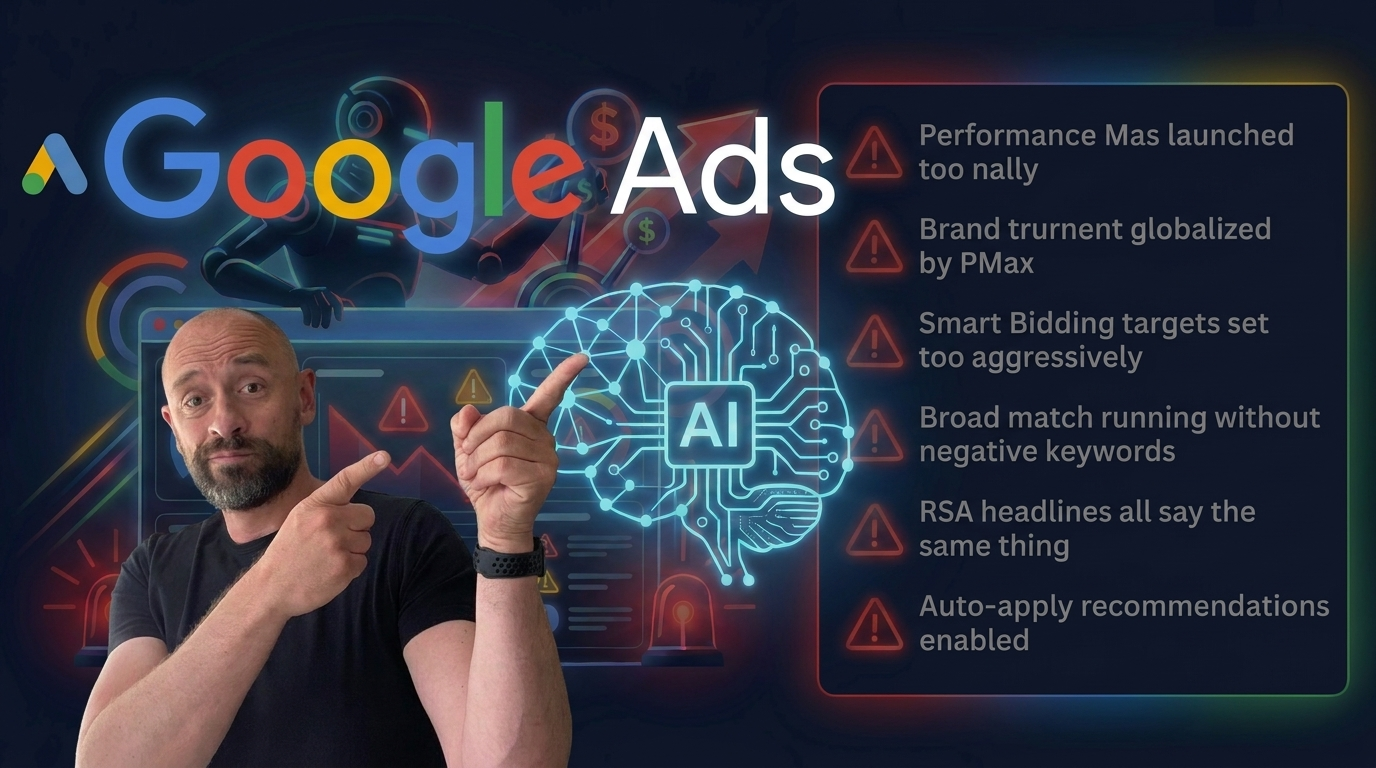
Google's AI promises to do the hard work for you. Set a goal, provide some assets, and let the algorithm find your customers. In practice, it's more complicated than that. The AI is powerful — but it amplifies whatever you give it, including your mistakes.
These are the six mistakes we see most often when auditing Google Ads accounts that run heavily on automation. You don't need to manage campaigns yourself to understand them. In fact, understanding them is exactly what makes you a better client — and lets you have more meaningful conversations with whoever is running your campaigns.
Watch: why AI amplifies your mistakes
A practical walkthrough of the six mistakes covered above — and how to avoid them.
1. Performance Max — running the most powerful campaign type before you have enough data
Performance Max (PMax) is Google's fully automated campaign type. It runs ads across all Google surfaces simultaneously — Search, YouTube, Display, Gmail, Discover, Maps — and lets the algorithm decide where, when, and to whom your ads appear. On paper, it's the most efficient way to capture demand across the entire Google ecosystem.
The problem: PMax requires a minimum of 30–50 conversions per month to learn effectively. Below that threshold, the algorithm doesn't have enough signal to optimize. It keeps spending — your budget disappears — but performance stays flat or erratic because the system is essentially guessing. Many accounts activate PMax too early, before the conversion data foundation exists to make it work.
A study analyzing over 4,000 PMax campaigns found that when the data foundation is strong, results can be excellent. When it isn't, the campaign burns budget without building meaningful learning.
✓ What good looks like
PMax runs alongside established Search campaigns that are already generating consistent conversions. It's introduced as an expansion layer, not as the foundation — and only once there's sufficient historical data for the algorithm to learn from.Question to ask your agency
"How many monthly conversions are we generating before we activated Performance Max, and is that above the 30–50 threshold Google requires for effective learning?"2. Brand Cannibalization — paying for traffic you were already going to get
Performance Max operates with higher campaign priority than your regular Search campaigns. When someone searches for your brand name — people who already know you and were going to click anyway — PMax can intercept that traffic and claim the conversion. Your dashboard shows strong ROAS numbers. But a significant portion of those "AI-driven" conversions were already yours. You're paying for demand that existed organically.
Research from Optmyzr across 503 accounts found that 91% had keyword overlap between Search and PMax, and in those overlap scenarios, Search campaigns outperformed PMax on conversion quality nearly twice as often. The AI is cannibalizing your own best-performing traffic and inflating the results it reports.
The fix — adding your brand name to an account-level exclusion list — is straightforward. But it requires someone to actively implement it. Without brand exclusions, PMax defaults to claiming the easiest conversions: people searching for you by name.
✓ What good looks like
Brand terms are excluded from PMax and handled by a dedicated brand Search campaign where bids and ad copy are fully controlled. PMax is focused on finding new customers, not reclaiming existing demand.Question to ask your agency
"Have brand exclusions been set up in our Performance Max campaigns? And can you show me how branded versus non-branded traffic splits across our campaign types?"3. Smart Bidding — setting targets the algorithm can't reach
Smart Bidding strategies like Target CPA (cost per acquisition) and Target ROAS (return on ad spend) sound like a dream: tell Google what you want to pay per lead or what return you need, and the algorithm optimizes toward that goal. In practice, the target you set has a direct, counterintuitive effect on volume.
If you set a target that's significantly more aggressive than your historical performance — say, a €30 target CPA when you've been averaging €80 — the algorithm restricts how many auctions it enters. It becomes so selective in its pursuit of the target that your impression volume collapses, and you end up with fewer conversions than before, not cheaper ones. The system is working exactly as designed; you've just given it an impossible instruction.
The same happens in the other direction: targets set too loosely allow the algorithm to overspend on low-quality traffic. Getting the target right, and adjusting it gradually over time, is a skill in itself.
✓ What good looks like
Bidding targets start within 10–20% of actual historical performance and are adjusted incrementally — no more than 5–10% at a time, with at least two weeks between changes to allow the algorithm to restabilize after each adjustment.Question to ask your agency
"What are our current Smart Bidding targets, and how do they compare to our actual historical CPA or ROAS over the past 90 days? When were these targets last adjusted and by how much?"4. Search Campaigns / AI Max — broad match without guardrails
Broad match keywords combined with AI bidding give Google maximum freedom to decide which searches trigger your ads. Google's own data suggests this combination can find more conversions than narrow keyword strategies. What Google doesn't advertise: broad match in 2026 is dramatically more aggressive than it was even two years ago.
Analysis from earlier this year found that the average broad match keyword now triggers ads for 340% more search terms than in 2024, with only around 23% of those terms meeting advertiser intent criteria. A campaign for "HR software" can end up showing for "HR manager job vacancy" or "HR certification course" — searches that cost money and convert poorly.
The same risk applies to Google's newer AI Max for Search feature, which automates matching and creative alongside bidding. More automation means more surface area for irrelevant traffic — unless negative keywords are actively managed. Many accounts have negative keyword lists that were built once and never updated, while the algorithm continuously expands into new query territory.
✓ What good looks like
Broad match and AI Max are used alongside a rigorously maintained negative keyword list. Search term reports are reviewed at least weekly, and irrelevant queries are excluded on an ongoing basis — not as a one-time setup task.Question to ask your agency
"Can you show me our search term report for the last 30 days? And when was our negative keyword list last updated with new exclusions?"5. Responsive Search Ads — mediocre inputs produce mediocre ads
Responsive Search Ads (RSAs) let you provide up to 15 headlines and 4 descriptions. Google's AI tests combinations and over time converges on the versions that perform best. It sounds like a machine that turns raw material into strong ads. In reality it's closer to a mixer: the output can only be as good as what goes in.
The most common version of this mistake: all 15 headlines communicate roughly the same thing in slightly different words. "Leading software for HR teams." "HR software trusted by 500+ companies." "The HR platform built for scale." The algorithm tests these combinations, finds that they perform similarly — because they say the same thing — and reports a mediocre Ad Strength score. You're not testing different messages; you're testing synonyms.
Strong RSA asset sets include headlines that cover different angles entirely: a benefit, a proof point, a differentiator, a question, a specific offer. That variety gives the algorithm real options to optimize across — and produces meaningfully different ad combinations for different search intents.
✓ What good looks like
Headlines cover at least four distinct angles: a core benefit, a specific proof point or number, a differentiator from competitors, and a direct call to action. "Low performance" rated assets are replaced every 4–6 weeks based on data, not assumptions.Question to ask your agency
"Can we look at the asset performance ratings in our RSAs together? How many headlines are currently rated 'Low' — and what's the plan to replace them?"6. Account Management — auto-applying Google's recommendations
Inside Google Ads, there's a feature called Auto-Apply Recommendations. Google analyzes your account and suggests changes — add keywords, broaden match types, increase budgets, enable new features — then offers to apply them automatically without requiring manual review. The interface makes this look like free performance improvement.
The catch: Google's optimization score is calibrated toward Google's definition of a "well-set-up account" — which includes features that increase auction participation and spend. Auto-applying recommendations has been shown to consistently increase budget usage. Whether it increases your return on that budget is a different question, and one the recommendation engine doesn't optimize for. Your agency's goal is profit efficiency; Google's goal is platform adoption and volume.
This doesn't mean Google's recommendations are always wrong — some are genuinely useful. But each one should be evaluated by a human who understands your specific business goals before being applied.
✓ What good looks like
Auto-Apply Recommendations is turned off. Recommendations are reviewed manually during regular account audits, and each one is accepted or rejected based on whether it serves your conversion goals — not Google's optimization score.Question to ask your agency
"Is Auto-Apply Recommendations turned on in our account? If so, which recommendation categories are being auto-applied — and can we review the change history to see what's been added automatically?"The pattern behind all six mistakes
Every mistake on this list follows the same logic: the AI is given insufficient inputs, the wrong constraints, or no constraints at all — and then optimizes powerfully in the wrong direction. Google's algorithms aren't trying to deceive you. They do exactly what they're told. The problem is that "maximize conversions" and "maximize profitable revenue for your business" are not the same instruction, and the AI can only optimize for what it's explicitly given.
The role of whoever manages your campaigns is increasingly less about manual bid adjustments and more about data quality, campaign architecture, and guardrails. AI can handle enormous complexity at auction speed — but it needs a human in the cockpit who understands where it's going, checks the instrument panel regularly, and knows when to intervene.
> AI in Google Ads amplifies what you give it. Strong data foundation, clear goals, and active oversight produce compounding results. Weak inputs and blind trust produce the same — just in the wrong direction.
Want an independent view?
We audit Google Ads accounts regularly. If you want to know whether any of these six patterns are playing out in your own campaigns, we're happy to take a look and give you a straight answer.
---
Part 1 of 3 — AI in your advertising campaigns. Part 2 (Meta Ads) and Part 3 (LinkedIn Ads) are coming soon.